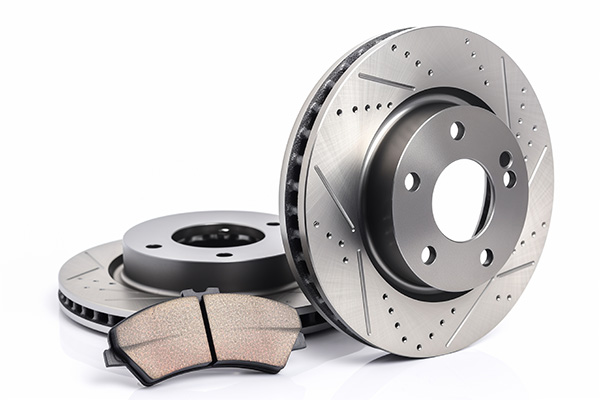
Brake service often begins with a familiar symptom: squealing, grinding, longer stopping distance, or a technician pointing out that the pads are getting thin. Then another question comes up when the estimate is prepared. If the brake pads are worn, what happens to the rotors sitting behind them?
Pads and rotors work against each other every time the vehicle slows down, so their condition is closely connected. Still, they do not always wear at exactly the same rate. Rotor thickness, surface condition, heat damage, previous brake work, and manufacturer specifications all influence what should be replaced during a brake repair.
How Brake Pads and Rotors Work Together
Brake pads are pressed against the rotor when hydraulic pressure moves the caliper pistons. Friction between the pad material and the rotating disc converts vehicle motion into heat, slowing the wheel.
Each braking event removes tiny amounts of material from both surfaces. Pads are designed to wear considerably faster, but rotors also become thinner over time. Their surfaces can develop grooves, rust, heat spots, or variations that affect how the new pads contact them.
Do Pads and Rotors Always Need Replacement at the Same Time?
No. Brake pads and rotors do not automatically need to be replaced as a set every time the pads reach their service limit.
If a rotor remains within the manufacturer's thickness specification, has an acceptable surface, and shows no damage that makes continued use inappropriate, it may be possible to install new pads without replacing that rotor. The decision should be based on actual condition and measurements rather than a blanket rule.
Rotor Thickness Is One of the Most Important Checks
Brake rotors have a minimum allowable thickness specified by the manufacturer. As the rotor wears, its ability to manage repeated braking heat changes decreases.
Technicians measure rotor thickness with a micrometer and compare the result with the specification. If the rotor is already at or below its discard thickness, it should be replaced. A rotor that is barely above the limit may also be a poor candidate for continued service because additional wear will occur during the life of the new pads.
Surface Condition Can Rule Out Reusing a Rotor
Thickness is not the only consideration. A rotor can measure above minimum specification and still have a surface that is unsuitable for another set of pads.
Deep grooves, heavy scoring, severe rust, cracking, or significant heat damage can interfere with pad contact. A pronounced outer lip also indicates that substantial rotor wear has occurred. An inspection allows the technician to evaluate both the friction surface and the areas around the rotor hat, cooling vanes, and edges.
Why New Pads Sometimes Feel Worse on Old Rotors
New brake pads have relatively flat friction surfaces. If they are installed against heavily grooved or uneven rotors, only part of each pad may initially contact the disc.
That reduced contact can affect brake feel, create noise, and contribute to uneven pad wear while the new pads conform to the old rotor surface. Proper rotor condition helps the pads establish consistent contact across their working area.
Rotor Runout and Thickness Variation Can Cause Pedal Pulsation
A driver may describe a shaking steering wheel or pulsating brake pedal that becomes more noticeable during braking from higher speeds. In some cases, the rotor has developed thickness variation or excessive runout.
Installing new pads alone will not correct a rotor condition that is causing the pedal to pulse. The rotor needs to be measured and evaluated. Depending on its condition and available thickness, resurfacing may be possible on some applications, while replacement may be the appropriate repair on others.
When Can Brake Rotors Be Resurfaced?
Rotor resurfacing removes a small amount of material to create an appropriate friction surface. It can be useful when the rotor has enough remaining thickness and the design permits machining.
The rotor must still remain above the required minimum thickness after machining. Labor cost, replacement rotor cost, corrosion, existing wear, and the manufacturer's service procedures also influence whether resurfacing makes practical sense. On many modern vehicles, replacing worn rotors is often more economical than machining them.
When Replacing Pads and Rotors Together Makes Sense
Replacing both components is often recommended when rotor condition would compromise the new pads or when the rotor has too little usable life remaining.
Common reasons include:
- Rotors are below minimum thickness
- Deep grooves or scoring are present
- Severe corrosion affects the friction surface
- Rotor cracking or heat damage is visible
- Brake pulsation is linked to rotor condition
- Resurfacing would leave the rotor too thin
- The rotors are unlikely to last through another pad cycle
In those situations, replacing the pads and rotors together gives the new friction components an appropriate working surface from the beginning.
Should Rotors Be Replaced in Pairs?
Brake service is generally performed in axle pairs. If one front rotor needs replacement because of wear or damage, replacing both front rotors helps keep the left and right sides matched. The same principle applies to the rear axle.
Brake pads are also replaced as an axle set rather than changing the worn pads at only one wheel. Uneven wear from side to side can indicate a sticking caliper, seized slide pin, hose concern, or another problem that should be corrected during the repair.
Calipers and Hardware Need Attention Too
A brake job should involve more than removing old friction material and installing new parts. Caliper slide pins need to move correctly, pad contact areas should be inspected, and hardware should be evaluated for corrosion or damage.
If one pad is much thinner than its partner, technicians look for the reason before finishing the repair. A sticking caliper or restricted pad movement can ruin new pads and rotors much earlier than expected.
Brake Replacement Is Based on Condition, Not a Universal Mileage
There is no single mileage at which every vehicle needs pads and rotors. Driving habits, vehicle weight, traffic, terrain, braking style, corrosion, and brake system design can produce very different wear rates.
Checking brake condition during regular maintenance can identify thinning pads before they damage otherwise usable rotors. Measuring the components instead of relying only on mileage gives a clearer picture of what the vehicle actually needs.
Get Brake Pad and Rotor Replacement in Las Vegas and Henderson, NV, With Asian Imports
Asian Imports serves drivers in Las Vegas and Henderson, NV, with brake pad replacement, rotor measurement, brake system testing, and related repairs.
If your brakes are squealing, pulsating, grinding, or approaching their wear limit, contact Asian Imports to schedule brake service and determine which components need attention.